The Wolves of Midwinter

Monday, May 09, 2011

FantastyFreak's Countdown to BEA!! PLUS Information about the Game of Thrones Readathon Below.


Writing these posts with sustained interest is definitely a challenge when my blog has spurts of high readership than it starts to tank. So, for me to invest so much interest and energy into this blog for the next two weeks, would either earn me the title of being "crazy" or "remarkable."


Anyways for the next two weeks here, I pledge to write a post to nearly every day or every other day in anticipation of the E3, Comic-Con of the publishing world: Book Expo America. I'm planning to attend this bibliophile extravaganza May 25th. Before then, I'll be hosting many new innovations on this blog and updates to continuing series of posts including the infamous Vampire Chronicle's Philosophy post series.


Future series within the next week will include a "Song of Ice and Fire" Readathon. I feel isolated when striving to read through the series. Like Jon Snow, I feel like the bastard son of blogs because I feel rather neglected and stranded alongside a bleak looking wall. My only companion happens to be a promiscuous dwarf named "Tyrion" who has many accounts of his various conquests which sadly have nothing to do with military prowess.


Anyways, I've seen many blogs crumble to ashes when trying one of these series. It seems everyone is doe-faced when these sorts of occur. "Oh Fantastyfreak!" they'll say astonishingly. "Of course, I'm interested in joining your reading brigade! But, are you sure you want to promote the reading of something so profane, gruesome, and kinda risqué?"


"See, here dedicated blog readers, I feel that by reading this together we can overcome our discomfort with scenes that include a certain tribe of people called the "Dortraki." I think instituting this readathon will make the daunting task of reading these scenes and these hefty books far more enjoyable. I'm not saying they're bad books. Quite the reverse, they're actually the quintessential fantasy book with great examples of rich characters and well-assembled soap opera. But often, reading any book alone can be lonesome. Plus, some people just do not have enough perseverance to make it through each book.  So, I think through having me spark discussions about a set number of pages, I can convince people to take up arms and read along with me."


From this point on,I'll be including continuing commentary on my Twitter. If I gather enough interest through people joining my blog and the discussions here, I will reveal more surprises along the way.
FIRST ASSIGNMENT:
With my fervor for the series and also for this blog, I think this will be neat concept if people are willing to partake. Your first assignment involves ready the first 100 pages of Game of Thrones. On Wednesday, be prepared to have those pages read as I will be writing a post on the history of bastard sons. Also, I am planning to write some discussion questions for everyone to answer. Some topics will include discussion about omnipresent gender roles within the world, historical similarities to the "War of the Roses," and the first unveiling of the underside of all these characters. I believe that these books cleverly have archetype characters that persuade us to be comfortable within the confines of the story. Until, wise George R.R. Martin pulls these things apart and we start to realize the grand differences between this book and tradition. Could his series be trying to adjoin the elements of antiquity (with obvious comparisons with the War of the Roses) and contemporary social and political issues?

Immortal Obsession by: Denise K. Rago


 Similar to indie music, there is an off-branch of book publishing where the books published are physically published in low quantities while the largest margin are limited to electronic sales via Amazon Kindle or Barnes and Noble's Nook. Denise K. Rago's book Immortal Obsession  happens to fall in this growing market. Luckily, I happened to procure a genuine bound copy. For some reason, I haven't found the virtual Kindle or Nook editions to be irresistible enough for me to secure a transition from the old school format to the new school format.

  Suprisingly, Denise K. Rago definitely did not have immediate problems with engrossing us within the first severeal pages when our attention is fleeting. From about page one to page five, our attention spans are low, our base desires or Freudian ID is pretty overactive. So, it takes a talented writer to surmount these and fill us with only one desire to continue paging through her book. From the first few pages, I gathered the impression that Denise K. Rago was partially emulating Anne Rice's decadent, sensual style of writing. Ever since, Interview with the Vampire, has been published, there have been many imitations of Anne Rice's style. In the publishing world, whenever a large, iconic bestseller is featured in the market, writers become enviable and write books similarly to these authors to attain some similar sale figures to the best-seller. 

But, Immortal Obsession deviates from the Anne Rice style through incorporating known archetypes from many urban fantasy books. At parts, you can discern that there are elements of Richelle Meade and Anne Rice bundled in there along with Denise K. Rago's own unique interpretation of the vampire genre. Some people might even find the plot surrounding an enigmatic human girl with suspect powers being reminiscent of Twilight. But,Denise K. Rago's vampires are certainly not forswearing their chastity and their literary vampire nature: sometimes they can be quite the little nymphomaniacs.

Sprinkle in some fast-paced action sequences and back-stories similar to Angel and you start to notice that this book is an entertaining hodgepodge of all the author's favorite elements of the urban fantasy or paranormal romance genres. When I take note of this, I'm not criticizing her persay. But, I think the market is currently saturated with a lot of vampire books to the point where we cannot help but unconsciously involve some favorite elements that truly define this genre.

Overall, I did not find the book to be "poignant," or anything related to the term "legendary." In actuality, I found the book to be mostly a very entertaining read or a homage to the urban fantasy genre overall. Meaning, this book will not become the epitome of the urban fantasy genre but it would definitely be enjoyed by fans who tend to have leanings toward this genre and type of story-telling. Again, I did not find this book to be wholly profound in any measure. But, the book was definitely readable which is often a very hard comment to make especially since my attention does tend to wane by page three or four of many books. Unless, an author has an established plot line or some inkling of character development by page five then I normally don't even waste my time with the book. Fortunately, this book passed my hardest task of actually be a book that did not require dogged determination to finish. Yet, it certainly was not a book that will be memorable for any literary significance but that  stage is often very hard to reach.

So, if you're finding yourself vampire deprived this summer, I suggest that you read this book when in need of a good beach read! If you're expecting something that will ultimately replace Anne Rice then you might need to keep scouring the book shelves!


By the way, the author's page and blog happens to be here if you are interested in attaining more information about this book, click here.

Saturday, May 07, 2011

Eden


Every time it rained:
The moment where sunshine was denounced
In the name of the melodramatic dark sky
I visited the shadowy figure
Seated against the tallest oak
Buried Underneath the torn green umbrella
That was a natural feature of these aged woods

When I approached the figure, I chastened myself
For the menacing snore
But I continued to crawl in the mud and the undergrowth of the woods
Till I found myself seated close enough
To begin to feel the rapture
Of being cloaked in their shadow

The figure persistently ignored me
While I sat with my mouth agape
In shock over their darkened beauty
Somewhere in my mind, I recalled a few precious details about them
I made the figure resplendent and masculine
Then, I etched a sardonic smile and bedazzling eyes
All that was left was the hair to which I used my own
To offer the figure some resemblance of myself

Suddenly, the figure’s bodice became more voluptuous
As their breasts gained more density
Some other things completely vanished and
Left signs of a feminine anatomy in their trace
Yet the figure’s face was still remarkably steely
One could even say that it was still masculine

I approached the figure tentatively while
Contemplating whether to kiss them or not
In the human world, I would be smoldered by flames of ignorance
Then I would be expected to be incessantly burnt within
Some netherworld of the damned
To me, everyone who has ever loved virtuously and spiritually is there
Beseeching a curmudgeonly supreme being
For an ounce of true humanity

To love this figure irrevocably, I forswear abstractions of the human God
By bridging our souls, I rediscovered a new enigma
I felt connected to a new sense of God
One that was cloaked and abhorred by the world
But could be excised by the acceptance of the love that our heart bears

I overlooked the ambiguity of the shadowed figure’s self and kissed them
The façade of my wearied self sank away
Along with the chain of puritanical values
This kiss was neither bestial nor chaste
It was a kiss that cut deep to the spirit

Cradled in their arms
With all my insecurities vanishing
I felt my nihilistic self become forsaken
For once, I felt the gravity of my love for the grandeur of the world
Signaled by the rapid pacing of my heart and
The euphoria of feeling the authentic grace of the God
Too mysterious for the primeval senses

Tuesday, April 26, 2011


New Article on my Death Seer Blog!


Click the Image Above to be redirected to my other blog specially devoted to my novel in works, "Death Seer!"
Another Reflection upon the Absurdity of Hell


I am extremely disenchanted with Christianity due to the easy answers about hell or the malicious, inhuman depictions of it. Actually, I now identity as an agnostic because I just cannot rationally believe that one religion amongst an innumerable amount of other religious interpretations could be the paved road to heaven. It ignores our complex minds which are fraught with doubt. The idea of confident belief in something transcendent and unknowable makes the idea of blistering eternity for those who doubt even minimally seem both unreasonable and even sadistic.

I am afflicted with scrupulosity therefore the entire notion of hell was a mind poison for me. Once I started unraveling the logistical problems of it and the paradoxes it formed, I no longer could believe truthfully within superficial Christianity unless I feigned belief. But, what human could really control ever aspect of their minds when all of us view and synthesize thoughts and observations differently? If that is true, then why would we exempt certain people from hell just because someone had the best genetic predisposition towards having decisive beliefs in this vast number of mostly human created doctrines about the metaphysical world.

Also, I cannot honestly believe that any denizen of heaven could live peacefully with the knowledge that the people we love are in hell. Yet, some Christians cruelly denounce you for being too sentimental. But really, I must wonder if then God has some underlying prejudice towards those who are empathetic. I certainly cannot abide by a God's rules if that God was unforgiving towards the errors within my friend's thoughts or beliefs. This God that would cruelly punish those that see God differently and beyond the human construct would be called a sociopath within our reality.

Some forms of Christianity also have informed women who have shown to desire spiritual leadership roles to be hell bound. Recently, a well-admired priest in the Catholic church was excommunicated for showing support for women priests. Symbolically, the church felt that his views were heretical and adverse to God's laws. In many ways, these Christians would thus say that this priest was no longer bound to heaven.

Other Christian sects see this as a non-issue and therefore would not believe it to factor into God's decision upon whether we are to go to hell or not.

Essentially, the whole idea of hell was created all for the sake of preserving order in an agrarian culture. Also, it is a Machiavellian concept that insures believers a passage to heaven if they repent a certain prescribed number of times for certain vices. More importantly, every Christian has a different notion as to who goes to hell. Furthermore, we have varying ideas of things that are dictated by sins. Also, we tend to blindly vilify those who are aberrations. Instead of treating them kindly, we sentence them to hell in our minds because they do not fit within the social context of the church community. Essentially, this makes religion more similar to a society with certain conventions rather than a community fit for a being that cannot be bound to a litany of absurd doctrines.

Overall, I forbid myself to be unloving all for the sake coercing people into a human-created belief structure that certifies them eternal life. Also, I am disgusted by my former self-destructive thought process that kept me focused on only my salvation. In the end, Christianity was about creating a perfected visage that expressed doubt-free belief within doctrines I tricked my mind into believing. But when I really examined my beliefs, I felt filled with sin. Soon enough, a vicious cycle overtook where all my dreams and artistic thoughts were repressed all for the sake of forcing myself to believe in superficial, unprovable religious doctrines. Should I and other inquisitive people be condemned to hell just because we're wired to be artistic and unconventional thinkers? Are we to believe that God preordains people to hell based upon certain dispositions? How can anyone believe in this madness? Why would anyone forswear their right to love others or to humbly accept that God is an enigma just to have some earthbound religious structure acknowledge that you are destined to heaven?

Why should Christians believe ardently within something as cruel as a hell for the doubters or those whose thoughts about God deviate from the rest? Are we likening God to the most pettiest of school bullies? Basically if your theology is fallacious then you do not just get a bad grade and another chance for reexamination, you will be punished eternally for failing to perfectly conceptualize a supreme being in your human mind.

Tuesday, April 19, 2011

Within Temptation "The Unforgiving," Review:


When one envisions Within Temptation, one thinks of onstage pyrotechs, poufy dresses, operatic vocals, and bombastic music. Within Temptation has always been the iconic symbol for both the symphonic metal genre and female fronted metal genre. Anyone with exposure to this genre knows of this band’s existence and their importance within the obscure world of European, symphonic metal.
David Grohl, lead singer of Foo Figters summed up his feelings about the band this way: “Wow this is a trip; this music is pretty wild.”
Within Temptation has always had a versatile sound. With each new album, they are open to experimenting with their sound. With their newest album “The Unforigivng,” they are unforgiving about taking radical directions with their newest album.
“With this album, we felt the time was there to take a new step in our creative development, to take it further and broaden our horizon.” Said Sharon Den Adel, lead singer of Within Temptation.
Indeed, this newest album is certainly a daring move on Within Temptation’s part. Their past albums mainly have focused on providing filmic music that would suit the soundtrack of either Mission Impossible or Lord of the Rings.
With “The Unforgiving,” they are moving beyond ethereal, fantasy-esque music and focusing instead on creating gritty, 80’s inspired rock music. Along with this music, they tapped Steve O’Connell, comic book writer of BloodRayne, to provide the main narrative that in part inspired the music for this album.
In many ways, using a comic book story to provide a concept for their album is not wildly unexpected for this band. Their music has always been inspired by films and novels that greatly inspirit members of the band.
Some fans will be expectantly wary of the sound and even presentation of the album. In nearly all the music videos, Sharon has been stripped of her decadent dresses. Instead, she dons the attire of a bad- ass rock chick who seems unafraid of facing the stigmas that are still attached to female metal vocalists overall.
This perseverance and fierce determination propels the music at sonic speed. From the beginning of their first track “Shot in the Dark,” the character of the song is stymied by the unexpected death of someone close by an unknown nemesis. There is a subtle foreboding tone that is expressed through the staccato guitar notes. While Sharon’s cautious vocals exemplify the initial shock of this tragic turn of events. It seems that the “Shot in the Dark,” was the unpredicted tragedy that brings about the eventual start of her struggle and the overriding intensity of the album.
Preceding this first track are two tracks that mirror different reactions to this sudden turn of events. “In the Middle of the Night,” begins the unceasing momentum of the album. Throughout the song, we are thrust into the desperation of the character’s feelings. With this death, the character needs vengeance above all else to appease herself.  
The theme of vengeance has been recurrent in Within Temptation’s music. Both “In the Middle of the Night,” and “Faster,” work cooperatively to express the character’s unwillingness to be squelched by painful emotions. She will work tirelessly to bring forth justice in this unjust world of hers. In Faster, Sharon seems to scoff at the ineptitude of her status of victimhood within their past song “Caged,” by belting “I can’t live in a fairytale of lies.”  Relating well with the album’s title “The Unforgiving,” the character in this song has no reservations about being an assertive female especially when the lack of justice in the world demands it.
Nearly all the songs of the album seem to symbolically reflect the necessity for women in the world to emphasize their strength. By having the music take a departure from the saccharine sounds of “The Silent Force,”   to a far more darker and violent sound: Sharon seems to imply that female metal vocalists are not purely soprano vocalists. Additionally, a large, decorative princess gown is not a requisite part of Within Temptation’s sound.
As per usual, Within Temptation’s sound has been focused on creating an ephemeral sound that detaches us from the world. In this album, we are not only jerked from the world and seduced by Within Temptation’s epic sound. We are thrust into a universe where women do not need to constantly fit prescribed roles. Within their sound, Sharon does not need to maintain a high lilt to her voice to lull us into her sound. Instead, she can sing lower notes and still express a wealth of emotion.
At the end of their album, “Stairway to the Skies,” seems to express the character’s acceptance of death and the ambiguity of the existence of a higher power. Yet the song also speaks of the band’s artistic aspirations and their desire to rise above the confines of the labels of gothic metal, symphonic metal, or female fronted metal.
For Within Temptation, their sound is primarily focused on being a musical escape from the doldrums of genre music.   Effectively, this album maintains their high mark of quality while completely recreating the atmosphere of this sound.
Fantastically, the guitar sounds are far more pronounced. This helps in showcasing the talent of the formerly silent, retreating guitar sounds of “Silent Force.” Additionally, Sharon proves that she had a wide vocal range by powerfully singing in a lower range.
Often throughout the music, the band does pay homage to the fan’s strict expectations. There are subliminal traces of both Sharon’s soprano vocals and the Gregorian choir. For the most part, the band instead focuses on evolving and differentiating their sound.
In the end, they succeed by releasing one of their best albums thus far in their career. Every song is both distinct and important to the theme of this album. Moreover, this album definitely piques the interest of new fans since the album offer a new musical experience.
Above all, I cannot wait to attend their concert to hear these finely crafted songs being performed live. Both “Iron,” and “In the Middle of the Night,” will be great songs to stir excitement among crowds at rock festivals.

Thursday, April 14, 2011

My Complicated, Unknowable Spiritual Identity:

In our Christian culture, I often feel that we decry truth as being disruptive. This antipathy towards truth when dealing with belief causes people like me to feel sinful in writing admissions of this sort. Often, I feel admitting to hurting someone verbally or physically would be handled with more grace than someone who admits to having a complicated unbelief within the tenets of one religion. To admit your agnosticism or atheism is to become traitorous to the Christian world. Therefore, more often than not, you become the prodigal son who shall never return to the Christian church. Actually, the prodigal son was involved with frivolity thus it was easier for him to admitted back into the Christian flock. But imagine if he had an internalized conviction that his beliefs might all be for naught. Perhaps, they were fleshed out all due to appeasing people around him. What if the very design of his religion beliefs was formed out of coercion from others rather then through vying to understand himself first?


For now, with some aplomb, I admit that I can no longer associate or identify myself with the Christian church as an institution. First off, I cannot have my beliefs be homogeneously similar to the beliefs held by other Christians. Moreover, I am unable to will myself to believe that a myriad of people on this Earth are wasted creations. Due to being created differently and being born within an entirely different culture, they have found that their religious identity is not that of a Christian. In order for myself to abide by the Golden Rule, I forbid myself from revering an interpretation of God that would force eternal punishment upon these people due to uncontrollable, inborn circumstances. I tried desperately to believe within the love and salvation of Christ but often that belief is trivialized by the belief within an infernal realm that declares these people with whom we think as inferior to be forced into hell.

Trying to live a Christian life has been destructive for me. Vying to form an acceptable facade of being devout caused me to form self-destructive behaviors. For the second part of my life, I have abhorred every piece of myself. In order to be complicit with the unreasonable laws of Christianity, I allowed all my questions and my inquisitive nature to forcefully be repressed. Throughout my life, I highly believed that many of the Bible stories were mythic in their function to explain a higher, inexplicable plane of existence. Tragically, many Christian tenets require us to make  our Christian beliefs superficial to the point where we disallow the questions from forming and squelch our confused, limited human spirits.

Regularly, I felt like I was crushing my unidentified spiritual self into a prison. While, I unconsciously formed a preferable, sanctimonious visage. Every instance where a question, an unholy passion, or any vestige of my true self penetrated this facade, I exerted my energy daily into abusing myself to make me acceptable to others. As a result, my Christian identity felt false. It was nothing more than a gaudy facade to humanize me in the eyes of others.

When I nearly reached the brink of my level of disillusionment with my self,I felt a great need to know myself. As I nearly destroyed my very existence along with my repressed spirit, I felt that my hatred of my very self has been caused by a omnipresent demand by Christianity to treat my neighbors unkindly. Whenever, I expressed empathy for my gay friends, atheist, agnostic friends, or those of differing beliefs; I had to cruelly and sadistically accept that they are unbelievers that are destined for hell. As a part of accepting that belief, I had to dehumanize them within my mind as a part of accepting the blistering, inhuman notion of hell. My love for them had to be feigned like my supposed belief in the supremacy of the religion. I had to constantly reform myself and assert an arrogant, unyielding belief in things that are unprovable.

Instead of furthering this self-destructive path, I am officially not identifying myself as a Christian. I feel that I cannot love others by remaining in this polarized religion. Also, I feel that I cannot be selfless or open minded in a religion where more often than not that attitude is frowned upon because it expresses doubt within a religion that requires strong, unexamined beliefs. I’m thoroughly sick of offering mutinous smiles to my non-Christian friends.

More importantly, I am tired of falsifying my beliefs when I do not believe that Bible should be taken literally. I cannot believe in the unscientific belief in Noah’s Ark or the symbolic story of Adam and Eve. Personally, I believe that the Bible like any religious text is an attempt to explain the unknowable nature of God. To believe that we know everything there is to know about God is a lofty, impossible belief. The only method to believe in unprovable beliefs requires scare tactics. My Christian experience has been filled with apprehension: I felt that forcing my mind to pretend to have beliefs in God would earn me recognition as a human being.

Do I still believe in God? Yes, but I do believe that God, for me personally, is inscrutable in the context of Christianity. Freeing myself from this nominal label has made me feel more authentic. St. Augustine interestingly cautioned people against fabricating falsehoods to earn the respect of other humans. In many ways, my Christian belief was dictated by the social necessity to fit in. It never had anything to do with believing in God.

By disbelieving in Christianity, I have attained a stronger belief and appreciation for an artful, ineffable God. Also, it has allowed me to love others and it also has augmented my empathetic powers. For once, I am joyful and completely unbound. Unexpectedly, I have stronger moral beliefs that pertain to refraining from judging others and learning to love without inhibitions. For once, I have an unrestricted joy for the person I am who has been crafted by a God that does not require a cloistered religious institution.

Above all, I can be intellectually humble. I do not carry any biases or selfish qualities when approaching people with differing religious beliefs. To some extent, I am able to love and be emotive without feeling guility. Trapped in a Christian identity, I felt incapacitated by an insistence by others that sensitivity was dangerous. Throughout my childhood, I was bullied incessantly for being sensitive. Furthermore, the church itself was not a safe haven from me because it promoted that same prudish dislike for people who differ from archetypes. Meaning, if you are not a “masculine,” male or a “feminine” female then you are not living the Christian life. The same thing applied for nearly all my qualities like empathy, humility, and inquisitiveness. These things supposedly engender a toxic individuality therefore I must make them deplorable. To be moral, I had to conform to a distant,unfamiliar identity. If I could not settle into that identity, I had to painstakingly pray to God to make this self sink away to my subconscious.

I know I will be faced with the indignation and the confusion from many of my Christian friends. Yet, this admission has made my toxic anger dissipate. I no longer have to attend church and feel incensed towards every part of my self. Instead, I am liberated by the knowledge that my pacifistic self is not something to hate. A God that supersedes our understanding does not require me to selfishly hate myself for not being what the world defines as “masculine,” or “moral.” Instead, I can freely pursue my dream to learn everything I can about spirituality and the reasons for our need for belief in the metaphysical elements of the world. Above all, I want to have a real relationship with God even if the world identifies me as an agnostic, Unitarian, or a Quaker.

Now, I am no longer a nominal Christian. I’m a person who feels that their spiritual identity has no moniker. Instead, I strive to understand the universality of our human experience rather than a closed idea of that experience. I aspire to be a religious historian of some sort; I desire to see the interconnectedness of all the world’s major faiths. Religion, to me, is a beautiful aspect of my life as long as I can remain an observer from the distant with my questions being freely embraced.

Tuesday, April 12, 2011

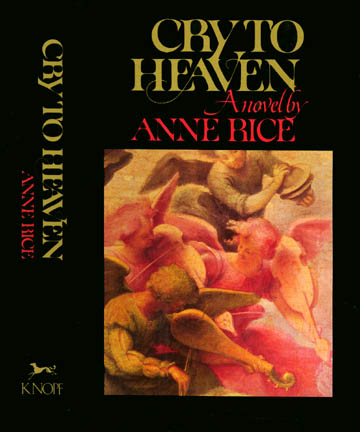
Cry to Heaven By: Anne Rice Review


  Anne Rice has granted voice and humanity to witches, assassins, vampires, and other supernatural creatures. Unbeknownst to some others, she has also utilized her literary skills to provide voice to eunuch choir boys from around the time of the Italian Renaissance. Commonly, readers are accepting of bloodthirsty vampires who produce death due to blood being a necessity for survival. Contradictorily, when it comes to eunuchs, readers are often less sympathetic and perhaps even apprehensive. We are desensitized to murder to the extent where it does not seems as morally wrong. Whereas, persons with ambiguous gender identification are castigated due to their unlocked and unknown potential. Therefore, in an effort to minimize this mystery, we brand these individuals as disordered and refuse to read stories where they appear fully human. 

   Wisely, Anne Rice uses this prevailing apprehension to her advantage. At the beginning, we can readily empathize with Tonio's plight and struggles because he has not yet been transformed into society's largest fear: the androgynous figure. Comfortably, we feel kinship with him because he has set, definitive gender roles. This male archetype allows Anne Rice for us to nestle safely within the story before being confronted with his literary "fall from grace." Mary Shelley's Frankenstein works similarly when we are greeted with Dr. Frankenstein, in that story, before he deviously invents an aberration of humanity.

Due to Christian ethos, gender expression is something that we wrongly believe to be  static. According to that ethos, male and females should work adversely against their spiritual selves and mindlessly conform to some accepted archetype. Individuals that deviate from these comfortable archetypes are ill-treated and feared. Frankenstein worked more metaphorically in that he represented the outsider of society that hardly any humans can seek to empathize with. Our compromised morals often cloud our consciences from forming instinctive desires for true morality where we genuinely feel compassion for our fellow human: we feel a sincere bond of kinship for a person's spiritual worth.

In Anne Rice's literary world of eunuchs, music serves as the spiritual catharsis for the bereaved eunuchs who are not accepted by their culture. Within this music, they are imbued with a sense of passion and purpose within a world that has sought to debase them. Their angelic voices are the manifestation of intrinsic worth and beauty: it is the formerly suppressed spiritual self that is desirous of recognition.

Often in our world, our religion is soulless. Instead of being pervaded with a sense of appreciation for the diverse beauty of our selves, we are instructed to abhor the most deplorable parts. For an institution to gain power, there always has to be a stigmatized, scapegoated minority. Without that, the institution then cannot salvage their reputation by diverting people's attention from their own sin. There has to be a condemned, heretical group that will serve as the model of being biologically unfit for God's acceptance. With relation to Calvinistic principles, the people who are biologically suited for the religious life will thus earn acclaim and a higher place within the invented hierarchy. In this earthbound scheme of heaven and hell, it is not a rift between the sinful and the sinless. Reversely, it is the segregation between normality and abnormality, theist and atheist, and men and women.


Anne Rice's "Cry to Heaven," book is an immense book that expresses different messages for different people. For the musically or artistically inclined, it offers a message of acceptance for those people who often feel overlooked or misunderstood for their radical imaginations. In another sense, the book acts as an exploration of that largely ignored population in our world that fits neither the societal gender role of male and female. Yet, the book shows that their only means of attaining acceptance comes through having some profitable utility. It also shows that this utility characterizes the eunuchs as being both human and spiritual creatures. Therefore, they are not so different from those who comfortably blend within the female and male world.

This book is evocative and richly textured. Reading it will take a long length of time to fully appreciate and process the implications and purpose of the story. Like many of Anne Rice's other books, it can often feel excessively rich at points due to a few instances where the description dominates the story and character development. But, this problem is often alleviated quickly when Anne Rice rectifies this with wonderful sequences where the character, plot, and poetic descriptions work jointly to create an  addictive, purposeful reading experience. After reading this book, you will certainly be dreaming long after of all the sumptuous images and complex details of this splendid story.